You are riding on a beautiful white horse.
On your left side is a drop off.
On your right side are several ostriches being chased by a lion.
In front of you are four large gazelles that won’t get out of your way
and you can’t seem to overtake them.
Behind you is a stampede of horses.
What must you do to get out of this highly dangerous situation?
For the answer click and drag your mouse from star to star.
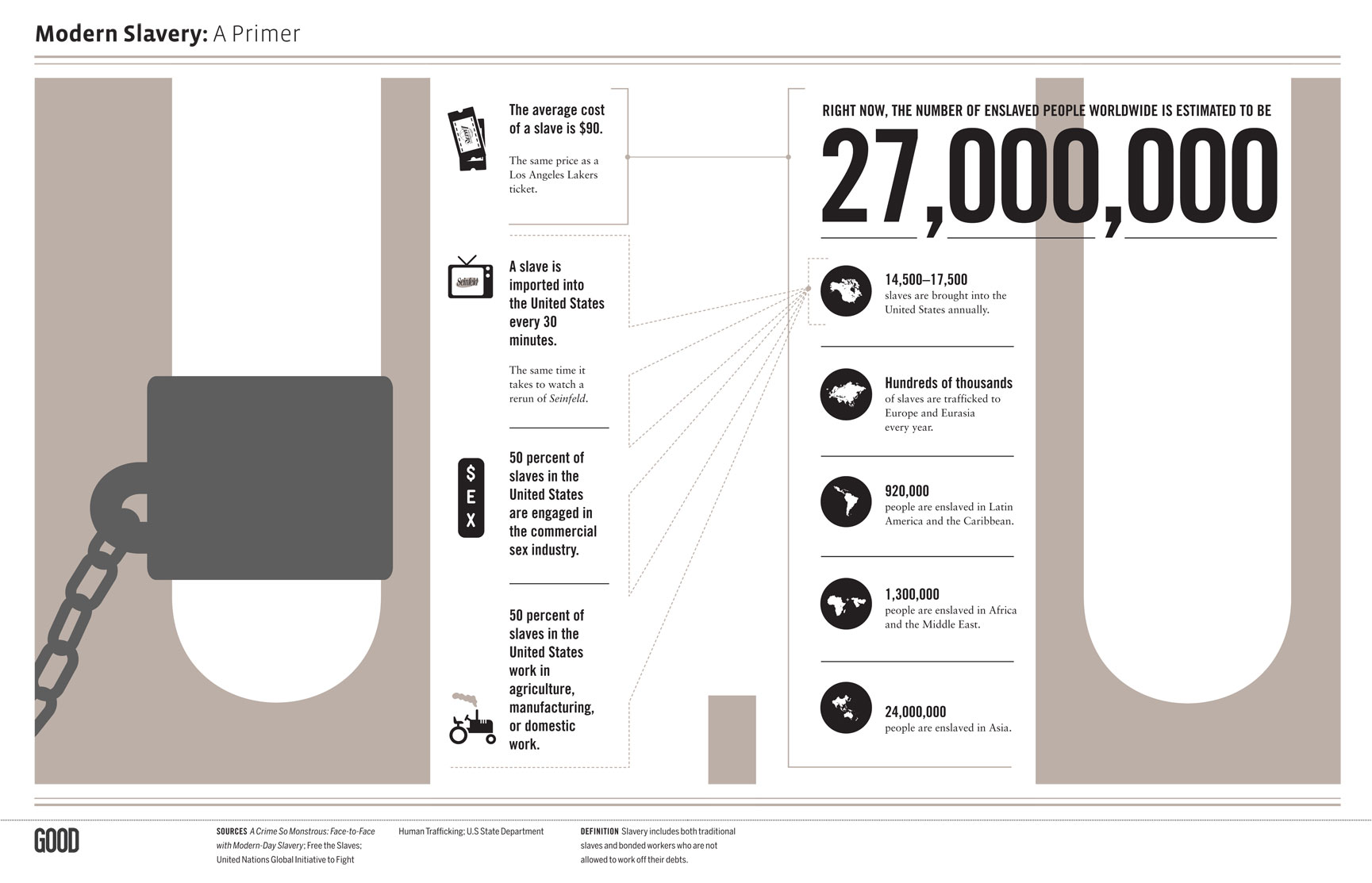
Standing in New York City, you are five hours away from being able to negotiate the sale, in broad daylight, of a healthy boy or girl. He or she can be used for anything, though sex and domestic labor are most common. Before you go, let’s be clear on what you are buying. A slave is a human being forced to work through fraud or threat of violence for no pay beyond subsistence. Agreed? Good.
Most people imagine that slavery died in the 19th century. Since 1817, more than a dozen international conventions have been signed banning the slave trade. Yet, today there are more slaves than at any time in human history.
And if you’re going to buy one in five hours, you’d better get a move on. First, hail a taxi to JFK International Airport, and hop on a direct flight to Port-au-Prince, Haiti. The flight takes three hours. After landing at Toussaint L’Ouverture International Airport, you will need 50 cents for the most common form of transport in Port-au-Prince, the tap-tap, a flatbed pickup retrofitted with benches and a canopy. Three quarters of the way up Route de Delmas, the capital’s main street, tap the roof and hop out. There, on a side street, you will find a group of men standing in front of Le Réseau (The Network) barbershop. As you approach, a man steps forward: “Are you looking to get a person?”
There’s at least one job these days that’s recession-proof, if you can handle shark-infested seas, outrun some of the world’s most powerful navies and keep your cool when your hostages get antsy.
A pirate’s life in Somalia isn’t for everyone. However, nothing comes easily in one of the poorest and most unstable countries on Earth, and when you consider the dearth of career options for Somalis on land, a pirate’s life starts to look more than cushy by comparison.
Residents say that the pirates are building houses, buying flashy cell phones and air-conditioned SUVs, gifting friends and relatives with hundreds and sometimes thousands of dollars and winning the attention of beautiful women, who seem to be flocking to pirate towns from miles around.
“The pirates are the hottest men in town,” Abdi said. “Girls from all over Somalia moved here to marry pirates. But if the girl isn’t cute she’s out of luck, because the pirates only go with beautiful girls.”
BYD Co., the Chinese automaker backed by Warren Buffett, started selling the world’s first mass-produced plug-in hybrid, gaining an edge on Toyota Motor Corp. and General Motors Corp. in electric-powered vehicles.
The F3 DM can run for 100 kilometers (62 miles) using only batteries, Shenzhen-based BYD said in a statement today. Toyota plans to begin testing plug-ins, which can be recharged from household powerpoints, late next year, it said in August. GM aims to start selling the Volt plug-in in late 2010.
Can someone explain why these cars are not on U.S. roads today?!?
Microsoft has issued a maximum severity rating of ‘critical’ for all versions of the browser and encourages all users to deploy the update – which is a piece of specially written computer code – as soon as it becomes available.
Due to the flaw, ‘Trojan horse’ viruses can be injected into the software of millions of computers, allowing criminals to remotely access and operate them.
Hackers in China are at the centre of the cyber attack, which is the most serious in the history of Microsoft’s operating system. As many as 10,000 websites have already been compromised, according to anti-virus software producer Trend Micro.
 Jokes, Just Plain Silly | TheFourEyes December 24, 2008 |
  Comments (0)




























 .
.